

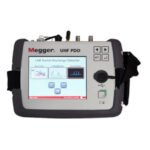

Description
IEC60270 Compliant Calibration Impulse Generators
calibration impulse generators are unique in that the charge pulse is generated by injecting a variable voltage step (correlated to an internal reference) via a fixed capacitor. This injection capacitor is relatively small, as the step voltage amounts up to 120 V for full range output. Therefore, the calibrators offer excellent impulse properties. Further, calculation of the correction factor is usually not necessary (CI<<CS). The broad range of easy-to-use and robust PD Calibrators for many different applications ensures reliable PD measurements compliant to international standards, such as IEC 60270 and CISPR 18-2. The standard calibrator CAL1A offers the charge range of 1/2/5/10/20/50/100 pC, while the CAL1B, mainly suitable for rotating machinery testing, covers the range of 100/200/500pC/1/2/5/10 nC.For transformer testing Adiradh energy offers four different models: CAL1C, CAL1D, CAL1G, CAL1J all of them being suitable for laboratory and online tests.
UHF impulse generators for Sensitivity Checks on GIS and Transformers
Special signal sources are available for GIS and transformer measurements using UHF, such as the CAL2A: 0.5/1/2/5/10/20/50 pC, rise time max. 200 ps, and f3dB min. 1.5 GHz. Three other models are available with voltage output, the CAL2B: 2/5/10/20/30/40/50 V, CAL2C: 1/2/5/7/10/12/15/17/20 V, and CAL2D: 5/7.5/1015/20/30/40; Z = 50 Ω, rise time max. 200 ps, tF = 100 ns. The rise time of the calibrators CAL2B/500, CAL2C/500, and CAL2D/500 is typically 550 ps.
Standard impulse generators of Power Diagnostix’ CAL2 series are listed in the table click this link, along with their ranges and key features
Calibrators for RIV Measurements
Power Diagnostix offers three different models of calibration impulse generators for RIV measurements: the CAL3A, CAL3B, and CAL3D. They all comply either with NEMA 107‑1987 or CISPR 18-2.All calibrators of the CAL3 series offer the charge range of 10 µV to 10 mV. The amplitude can be set in following steps: 0 µV, 20 µV, 50 µV, 100 µV, 200 µV, 500 µV, 1 mV, 2 mV, 5 mV, 10 mV.A rotary switch on the left side of the calibrator is used to select the signal frequency. The top position ‘0’ selects 600 kHz for the CAL3A. It is increased in steps of 50 kHz up to 1350 kHz. The standard frequency of 1 MHz is selected at lowest position ‘8’. The CAL3B and CAL3D offer a range of 400 kHz to 1900 kHz in steps of 100 kHz.



Reviews
There are no reviews yet.